
A motorcycle lift is one of the most useful investments you can make for your garage or shop. Whether you run a high-volume service bay, manage a dealership, or wrench on bikes in your spare time, the right lift puts your work at a comfortable height and protects both the bike and your back.
Not all lifts are built the same, and that’s something we see play out with customers every day. Weight capacity, lifting height, table width, and power type (air, air/hydraulic, or electric) all vary significantly across models, and choosing the wrong one means either paying for features you don’t need or buying a lift that limits what you can do.
We’ve put together this guide to walk you through every major factor to consider before you buy, and then break down our full lineup of Weaver® Motorcycle Lifts so you can match the right model to your setup.
Table of Contents
- Types of Motorcycle Lifts: What’s Available
- Factors to Consider When Shopping for a Motorcycle Lift
- Our Motorcycle Lift Lineup: Which One Is Right for You?
- Questions to Ask Before You Buy
Types of Motorcycle Lifts: What’s Available
Before diving into what to look for in a lift, it helps to understand what’s actually on the market. Motorcycle lifts range from simple, low-cost tools to full lift tables designed for daily shop use. Each type serves a different purpose and comes with its own trade-offs.
Floor Jacks and Scissor Jacks
Floor jacks and scissor jacks are the most affordable option, typically ranging from $30 to $150. They work by sliding under the frame or a specific lift point on the bike and raising one end at a time. They’re compact, easy to store, and useful for quick tasks like rear wheel removal.
The main limitation is that they only lift one point of the bike at a time, so the motorcycle stays at floor level for most service work. They also require the operator to crouch or kneel, and they don’t provide a stable platform for extended maintenance. Most mechanics use them as a supplement to a lift table, not a replacement.
Hydraulic Paddock Stands
Paddock stands support the front or rear of the bike by cradling the swingarm or fork legs, typically raising that end 8 to 12 inches off the ground. They’re a staple in track settings and are popular for at-home tire changes and chain maintenance. A front and rear stand together run $50 to $200 for a basic set.
Like floor jacks, paddock stands work one end of the bike at a time and keep the rider working at ground level. They also require a specific lift point that may not be accessible on all bikes, particularly cruisers and touring models with non-standard frame geometry.
Wheel Chocks and Front Stands
Wheel chocks hold the front tire in an upright position and keep the bike stable while parked or during light maintenance. They’re not true lift devices but are often used alongside paddock stands or in trailers and garages to secure the bike without a kickstand. Basic chocks start under $50.
Front stands that cradle the lower fork legs can free up the front wheel for removal, though they require the bike to already be stable at the rear. Like paddock stands, they serve a specific purpose well but are not a substitute for a full lift table when you need access to both ends of the bike at a workable height.
Motorcycle Lift Tables
Lift tables are the most capable option in the category. The entire platform raises to a comfortable working height using air, hydraulic, or electric power. With the right accessories, a lift table gives you access to every part of the bike from both ends and both sides, all while standing upright.
Lift tables range from around $750 for an entry-level hobbyist model to $2,000 or more for a commercial-grade unit with extended tables and high lift heights. They require more floor space and a larger upfront investment than the options above, but they’re the only type that provides a stable, full-access work platform for the full range of motorcycle service tasks.
Everything in our lineup at Derek Weaver is a lift table. It’s the type we most prefer because it’s the one that actually improves working height and saves your back.
Factors to Consider When Shopping for a Motorcycle Lift
Below are several key factors that you should research when in the market for a new motorcycle lift.
Weight Capacity
Weight capacity is the first number you should check on any lift. Most standard motorcycle lifts are rated at 1,000 lbs., which covers sport bikes, cruisers, and most touring bikes comfortably. If you regularly work on heavier touring models, large custom builds, trikes or ATVs, stepping up to a 1,500 lb. or higher-rated lift gives you the safety margin you need.
Overloading a motorcycle lift, even temporarily, can result in cylinder failure, structural damage, and serious injury. Always verify the wet weight of the heaviest vehicle you plan to load before settling on a capacity rating.
As a general rule: choose a lift rated higher than you think you need.
Air vs. Air/Hydraulic Lifts vs. Electric Hydraulic Lifts
There are three types of motorcycle lifts available, all using a scissor-style design. Each is powered differently, and the difference affects both cost and day-to-day experience. Here’s how we break it down for customers:
Air-powered lifts are the most affordable and most popular option. They operate on compressed air (typically 90–120 PSI) using a foot pedal, and they’re simple to maintain. The trade-off is that pure air lifts can feel slightly surgy on the way up and down. A standard 20-gallon air compressor is usually sufficient for several up-and-down cycles.
Air/hydraulic lifts use compressed air to push hydraulic fluid into the lifting cylinder. The result is noticeably smoother operation with more precise height control. We recommend these for commercial environments and for riders who want a more refined feel. They typically carry higher weight capacities as well.
Electric hydraulic lifts are powered by an integrated electric pump, which eliminates the need for a compressor entirely. They’re the most expensive type and are typically found in professional shop environments where convenience and maximum capacity are top priorities.
Lifting Height and Ergonomics
Lifting height is often underestimated as a buying factor. Most standard motorcycle lifts raise to around 30–33 inches, which gets the bike up off the floor but still requires some bending for detailed work.
Lifts that reach 42 inches or more bring the engine, frame, and wheels up to chest level, dramatically reducing fatigue during longer service jobs.
For home garage users doing occasional oil changes or tire service, a standard 30–33-inch lift works well.
For professional technicians spending hours at the bench, the ergonomic advantage of a taller lift pays dividends over the long run.
When evaluating lifting height, also check the lowered height of the table. Most start around 7–8 inches off the ground, which determines how easily a low-slung bike can be rolled on.
Table Size and Bike Compatibility
Table length and width directly determine which bikes you can service and how safely you can load them.
Most standard lifts come with a 24-inch-wide by 80–84-inch-long table, which handles the majority of street bikes, sportbikes, and standard cruisers without issue. Choppers and custom builds with extended wheelbases may need a table length of 93–106 inches or require a chopper extension add-on.
Width matters just as much as length. A 24-inch table works for motorcycles, but if you plan to service ATVs, trikes, lawn mowers, or other wider equipment, look for a model that includes side extensions or has an XLT configuration that expands the table to 48 inches. Side extensions also provide a platform to step down to when loading the bike, which adds a meaningful safety benefit. The side extensions also provide a step for your foot to land on while loading or unloading the bike.
Don’t overlook the rear drop panel. This removable section at the back of the table allows you to service the rear wheel, suspension, and brakes with the assistance of a W-BlackJack or stand. Most of our quality lifts include this feature, but the size of the panel varies. A full-width droptail is far more useful than a narrow drop-out slot.
High-Quality Lifts vs. Cheaper Lifts
Not all motorcycle lifts are built to the same standard, and knowing what to look for can save you from an expensive mistake. Price is the most obvious signal, but it doesn’t tell the whole story. Two lifts can look nearly identical in a product photo and perform very differently after a year of regular use. Here is what actually separates a well-built lift from one that will let you down.
Steel Gauge and Frame Construction
The thickness of the steel used in the frame and table is one of the most important quality indicators and one of the hardest to evaluate from a listing. Quality commercial lifts use 10 to 11 gauge steel throughout.
Cheaper lifts cut costs with thinner material that flexes under load, weakens at the weld points over time, and is more prone to permanent deformation under heavy or frequent use.
A well-built lift feels completely solid at height with no lateral wobble in the scissor arms and no flex in the tabletop when weight shifts.
Cylinder and Seal Quality
The lifting cylinder is the most mechanically stressed component on the lift. On a quality unit, the cylinder walls are thick, the seals are made from durable materials rated for long service life, and the tolerances are tight enough that the table holds its height without slowly creeping down under load.
Cheap cylinders use thinner walls and lower-grade seals that begin leaking within a year or two of regular use. Seal replacement is normal maintenance on any hydraulic or air cylinder over time, but it should happen after years of use on your schedule, not in the first season because the original components were undersized for the application.
Weld Quality and Finishing
Welds are where frame failures almost always start. Quality manufacturers use consistent, full-penetration welds at every stress point, particularly where the scissor arms connect to the base and the table frame.
On cheaper lifts, welds are often inconsistent, shallow, or skipped at secondary connection points. Over time, those become stress fractures. Powder coat quality is worth examining too. A proper finish is applied evenly, cured correctly, and provides long-term corrosion resistance in a garage or shop environment. Thin or uneven coating chips quickly, which leads to rust at the frame joints where moisture collects.
Safety Lock Mechanisms
On a quality lift, safety locks engage automatically as the table rises and require a deliberate action to release. The locking teeth are machined precisely so they seat cleanly at each position without slop or rattle.
On cheaper lifts, locks are often a single bar that slides manually into one of a few crude notches. That design puts the responsibility entirely on the operator to remember to engage the lock every time, and it provides far fewer height options. Automatic locks are not a luxury. They are the difference between a lift that protects you if something goes wrong and one that doesn’t.
Manufacturer Accountability
One factor that never appears on a spec sheet is whether the manufacturer can actually support the product after the sale. Established manufacturers maintain parts inventory, publish parts diagrams, and stand behind their warranty commitments.
Many of the lowest-priced lifts on the market come from manufacturers with no US presence, no parts availability, and no support infrastructure. When something needs attention, you are on your own.
Derek Weaver has been in business since 1984, and we only work with manufacturers whose products we can support. Parts are in stock, documentation is available, and when you call us, you get real help. That accountability is part of what you are buying when you purchase through
Safety Features to Look For
A motorcycle lift needs to keep the bike stable at height while you work around it. Here are the features we consider non-negotiable:
- Automatic safety locks: Locking positions that engage automatically as the table rises prevent the lift from dropping unexpectedly if air pressure is lost.
- Rubber-lined wheel vise: Secures the front tire without damaging the wheel finish. Adjustable crank-style vises provide the strongest grip on heavier bikes.
- Tie-down eyebolts: Motorcycle straps attached to eyebolts on the table are essential for preventing tip-over, especially during weight shifts while working. The wheel vise alone is not a substitute for straps. We always recommend using both.
- Stabilizer bar: Found on some of our commercial models, this crossbar adds lateral rigidity to the lift frame when the table is at height.
Accessories That Make a Real Difference
The right motorcycle lift accessories can turn a basic lift into a complete service platform. These are the ones we recommend budgeting for from the start:
- Motorcycle frame jack (W-Blackjack): A scissor-style jack that fits under the frame and lifts either or both wheels free of the table. Essential for wheel removal, brake service, and tire changes.
- Side extensions (XLT kit): Add 12 inches to each side for a total 48-inch width. Useful for ATVs, trikes, and larger equipment, and doubles as a step-off platform during loading.
- Chopper extension: Adds 13 inches to the table length for extended-wheelbase bikes. Necessary for choppers and long-frame customs.
- Lift dolly: Allows you to reposition the lift around the shop when the table is in the lowered position. Included with some models, optional on others.
- Motorcycle straps: Simple but critical. Always strap the bike to the lift using the eyebolts on the table, regardless of which model you choose. We carry straps on our website if you need them.
Our Motorcycle Lift Lineup: Which One Is Right for You?
Our Weaver® Motorcycle Lifts are sourced from the same class of manufacturers we rely on across our entire product lineup, including Vehicle Service Group (VSG), one of the largest and most established lift manufacturers in North America. VSG produces equipment for many of the biggest names in the industry, and our lifts are built to the same commercial-grade standards.
We source directly, which means you get that quality without the markup that comes with national brand names. Many of the models in our lineup have been sold for 20+ years with only minor updates, which is a testament to how well these designs hold up.
Every lift comes with a one-year warranty and is backed by our in-house customer support and parts inventory.
Here’s a breakdown of every current model:
Weaver® W-1000 Motorcycle Lift
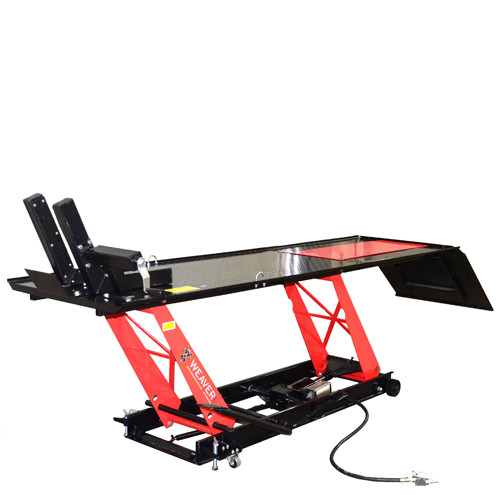
The W-1000 is the entry point in our lineup, designed for the home garage mechanic who needs a reliable lift at an accessible price. It runs on 120 PSI air or a foot pump (both included) with an 86.75” x 26.75” table, 1,000 lb. capacity, and a 30” lifting height. Standard features include a rubber-lined wheel vise, rear drop panel, and approach ramp. Four casters make repositioning easy.
Best for:
- Home garage users and first-time lift buyers
- Budget-conscious enthusiasts who do occasional maintenance
- Anyone who doesn’t have a dedicated air compressor (foot pump included)
Weaver® TX-1000 Motorcycle Lift
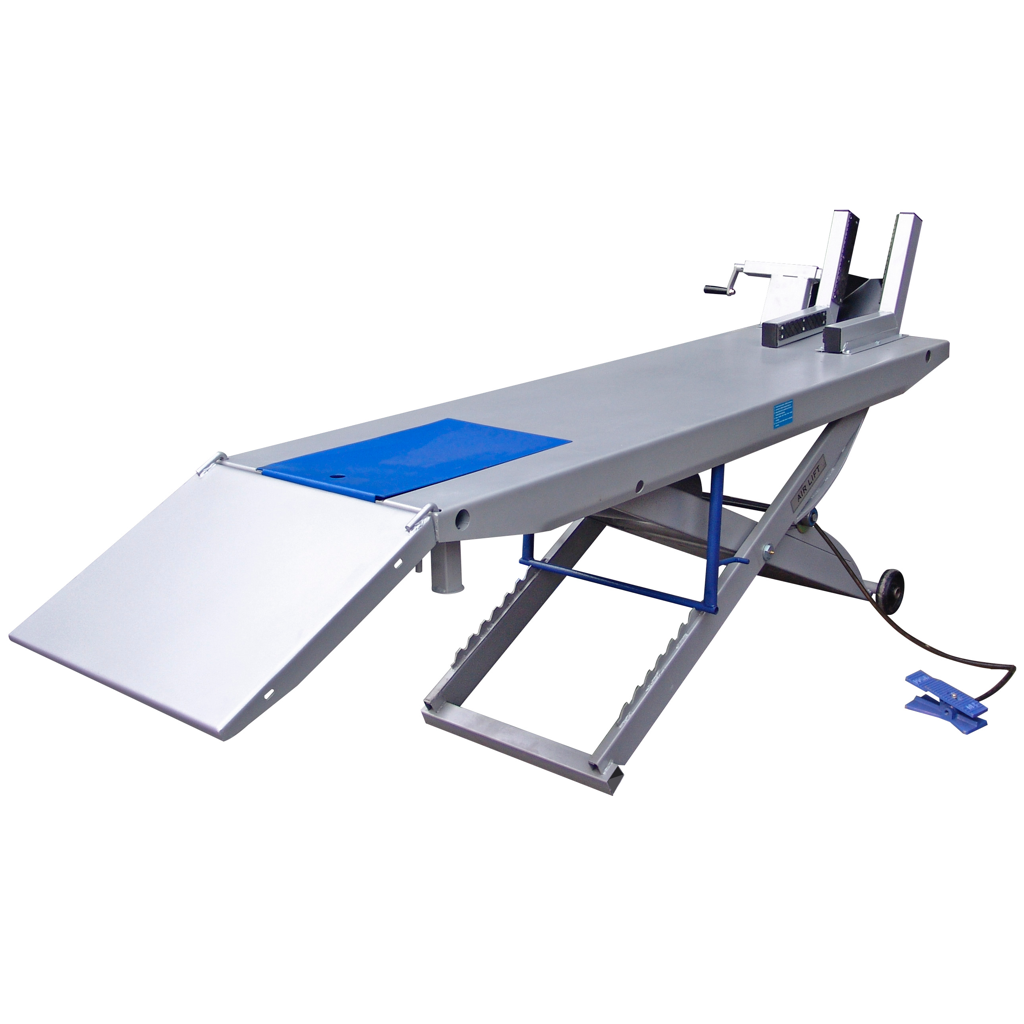
The TX-1000 steps up to commercial-grade construction while keeping the footprint compact. The 84” x 24” smooth-surface table, 1,000 lb. capacity, and air-powered operation make it a versatile everyday lift. The smooth top is easy to clean and holds up well in a busy shop environment. It accepts chopper extensions and our TX-Side Extension Kit for added versatility down the road.
Best for:
- Small to mid-size shops wanting commercial-grade durability at an approachable price
- Enthusiasts who want a step up from hobbyist quality
- Operators who want a clean, easy-to-maintain table surface
Weaver® TX-1000-XLT Motorcycle Lift
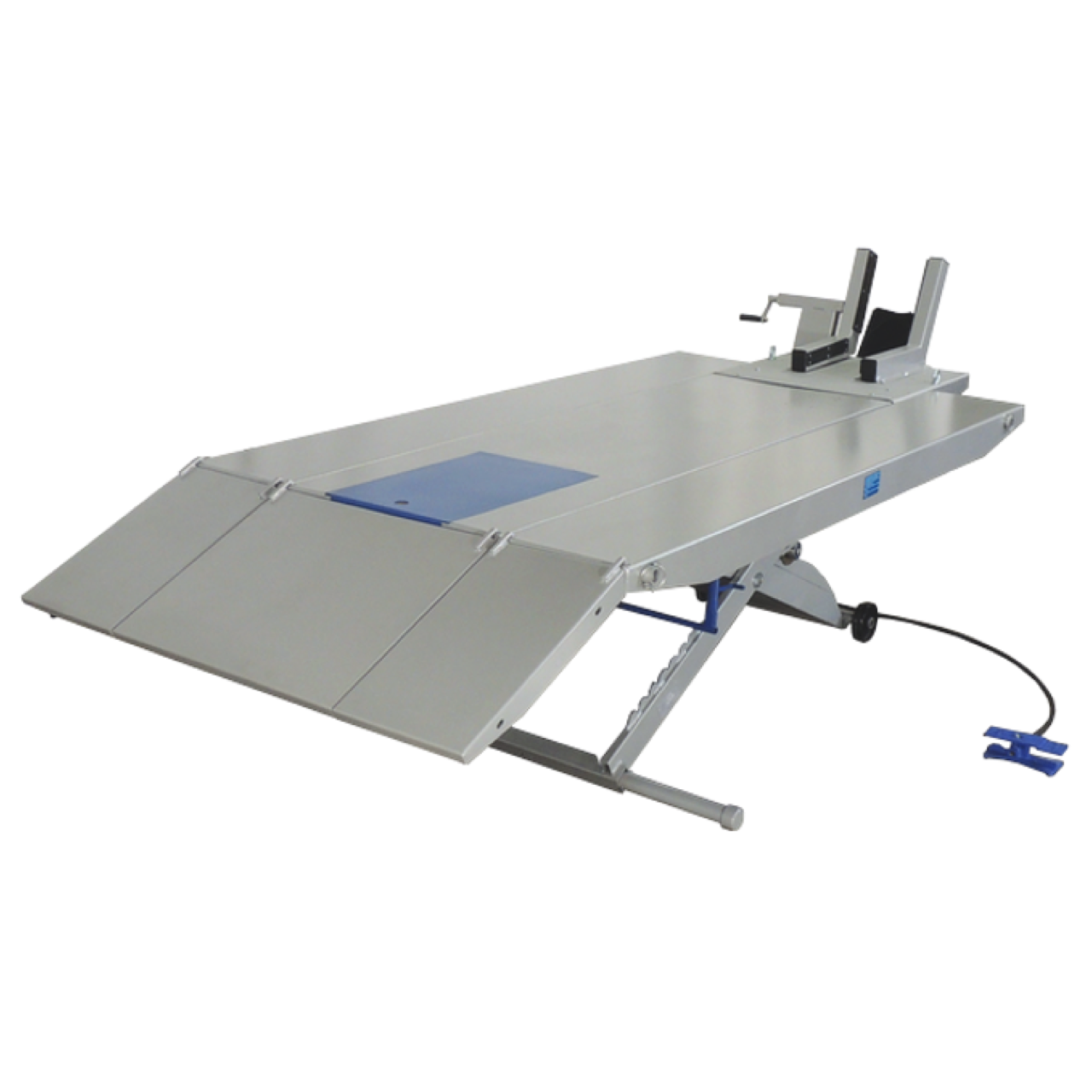
The TX-1000-XLT bundles our popular TX-1000 with the TX-Side Extension Kit, expanding the total table width to 48 inches. The extension system uses slide-through tubing and quick-pins so one person can add or remove the extensions easily. At this width, the lift handles ATVs, snowmobiles, lawn mowers, and other wide equipment in addition to motorcycles. Commercial-grade quality throughout.
Best for:
- Multi-purpose shops servicing both motorcycles and ATVs or powersport equipment
- Enthusiasts with multiple types of vehicles in the garage
- Anyone who wants maximum load flexibility without buying a second lift
Weaver® Pro-1000 Droptail Motorcycle Lift
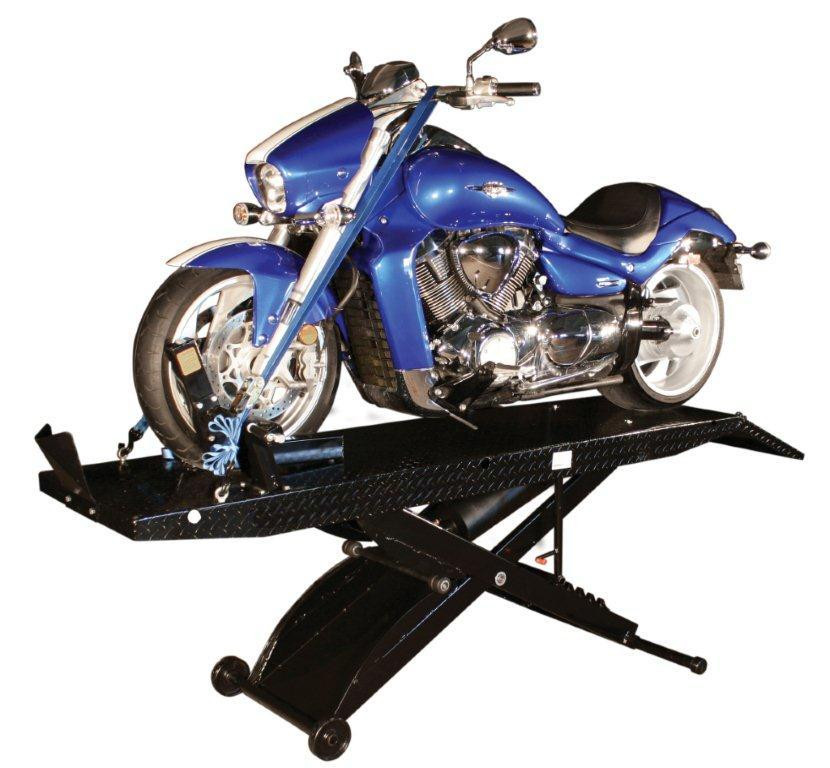
Our best-selling lift, with over 100,000 units sold. The Pro-1000 Droptail’s defining feature is its 19.5” removable rear end section. It’s not a narrow drop-out slot, but a full-width panel that accommodates even the fattest tires (300s and up). The 93” table is longer than the industry-standard 80–84”, and the Droptail gives you more total service access than any comparable lift at this price point. Runs on 90–100 PSI with 5 safety lock positions, a stabilizer bar, and rubber-lined wheel vise included.
Best for:
- Enthusiasts and professional shops who need full rear-end access for wheel, brake, and suspension work
- Bikes with wide rear tires (custom builds, baggers, touring models)
- Anyone who wants the most-proven lift in our lineup
Weaver® Pro-1000 Droptail CE Motorcycle Lift
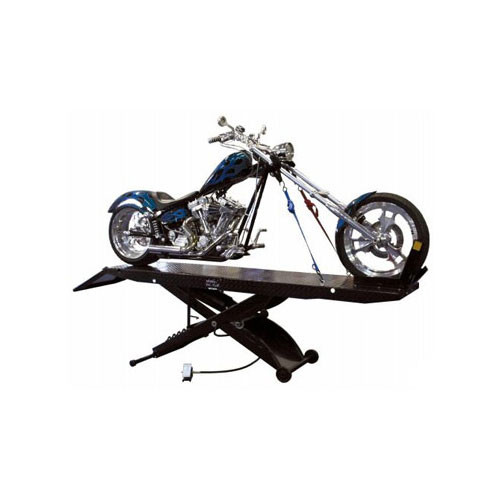
The CE model shares all the core specs and features of our Pro-1000 Droptail but adds a chopper extension, bringing total table length to 106 inches. At that length, you’ll be hard-pressed to find a motorcycle that doesn’t fit. The foot-operated air valve can be accessed from either side of the lift, a small but useful detail in a two-person shop.
Best for:
- Shops servicing choppers, long-frame customs, or extended-wheelbase builds
- Dealerships handling a wide variety of incoming bikes without knowing wheelbase in advance
- Hobbyists with large custom builds or touring bikes
Weaver® Pro-1000 Droptail XLT Motorcycle Lift
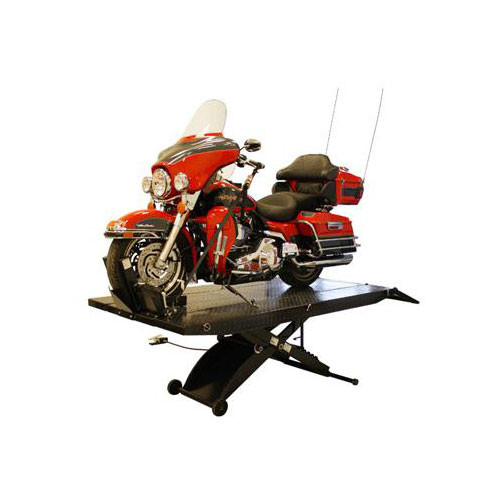
The XLT combines our full Droptail design with side extensions for a 93” x 48” work surface. The extra width lets the lift handle ATVs, mowers, and other wide equipment, and when used as a motorcycle lift, the extensions provide a step-down platform on either side for safer loading. Flip the extensions upside down and they double as a built-in tool tray, a genuinely practical feature in any working shop. Includes vise, foot valve, side extensions, and dolly.
Best for:
- Shops and dealers that handle both motorcycles and ATVs
- Anyone who wants the Droptail’s rear-end access plus wide-load capability
- Shops looking for maximum workspace flexibility in a single lift
Weaver® W-1500 Hi-Rise Motorcycle Lift
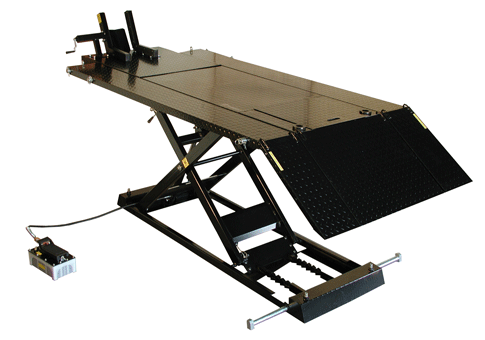
The W-1500 is the flagship of our motorcycle lift lineup. It steps up in three meaningful ways: 1,500 lb. capacity, 42.5” lifting height, and air/hydraulic power for noticeably smoother operation. The hydraulic fluid system eliminates the surging feel of air-only lifts and allows precise positioning at any of 6 locking heights. The 100” table (with front extension), full-width rear drop panel, side extensions, and rubber-lined vise are all included.
We specifically highlight the W-1500 when customers ask about ergonomics: that 42-inch height brings the work to chest level, which makes a real difference on long service days. It’s the lift we point shops to when technician fatigue and throughput are priorities.
Best for:
- High-volume commercial shops and dealerships that need smooth, reliable daily-use performance
- Technicians prioritizing ergonomics and reduced fatigue on long service days
- Shops servicing heavy touring bikes, trikes, or ATVs up to 1,500 lbs.
- Enthusiasts who want the most capable and complete package in our lineup
Questions to Ask Before You Buy
When customers call us before placing an order, these are the questions we walk through with them. Use this list to narrow your choice before you finalize:
What is the heaviest bike you’ll ever put on it?
Check the wet weight of your heaviest vehicle and choose a lift with a rated capacity above that number. If you’re running a shop, account for the heaviest bike a customer could ever roll in.
Do you need wheels-free service?
If you’re doing tire changes, brake service, or suspension work, we recommend budgeting for a Blackjack frame jack alongside your lift. The drop panel handles rear-wheel access; the Blackjack lets you lift the frame and remove both wheels without any additional stands.
How tall are the people using the lift most?
Taller techs benefit significantly from the 42”+ height of the W-1500. Shorter users may find 30–33” adequate. If the lift is shared across multiple technicians with different heights, we’d steer you toward the taller option every time.
Will you need to lift anything besides motorcycles?
If ATVs, trikes, mowers, or other wide equipment will go on the lift, choose an XLT model or one that accepts side extensions. The 48” width handles nearly anything in the powersports world.
Do you have an air compressor, and what’s the tank size?
Most of our lifts require 90–120 PSI. A 20-gallon tank is generally sufficient for several full up-and-down cycles. The W-1000’s foot pump option means you don’t need a compressor at all, which is a real consideration for home garages that don’t have one yet.
Ready to Get Your Bike Off the Ground?
One of the most common things we hear from first-time lift buyers is that they wish they’d purchased one sooner. Once you’ve worked on a bike at the right height, going back to crouching on the floor or wrestling with a hydraulic jack doesn’t make sense.
Whether you’re outfitting a busy dealership service bay, setting up a professional shop, or building out your dream home garage, our Weaver® Motorcycle Lifts are built to last and backed by decades of product knowledge and after-sale support.
Browse our full motorcycle lift lineup, or call us directly at 817-560-9510 if you want help matching a model to your specific setup. We stock parts, accessories, and seal kits in-house, so your investment is protected long after the lift arrives.
